Book: Angels & Demons by Dan Brown Food: Meatball Sauce Trapizzino
In an earlier blog post I wrote about using Dan Brown’s book, Angels & Demons, to structure a self-guided tour of Rome. My daughter, Lilly, and I stopped by St. Peter’s Square as part of that tour, but we had tickets to tour Vatican City the next day so we went no further than the square. Now it was time for Vatican City.
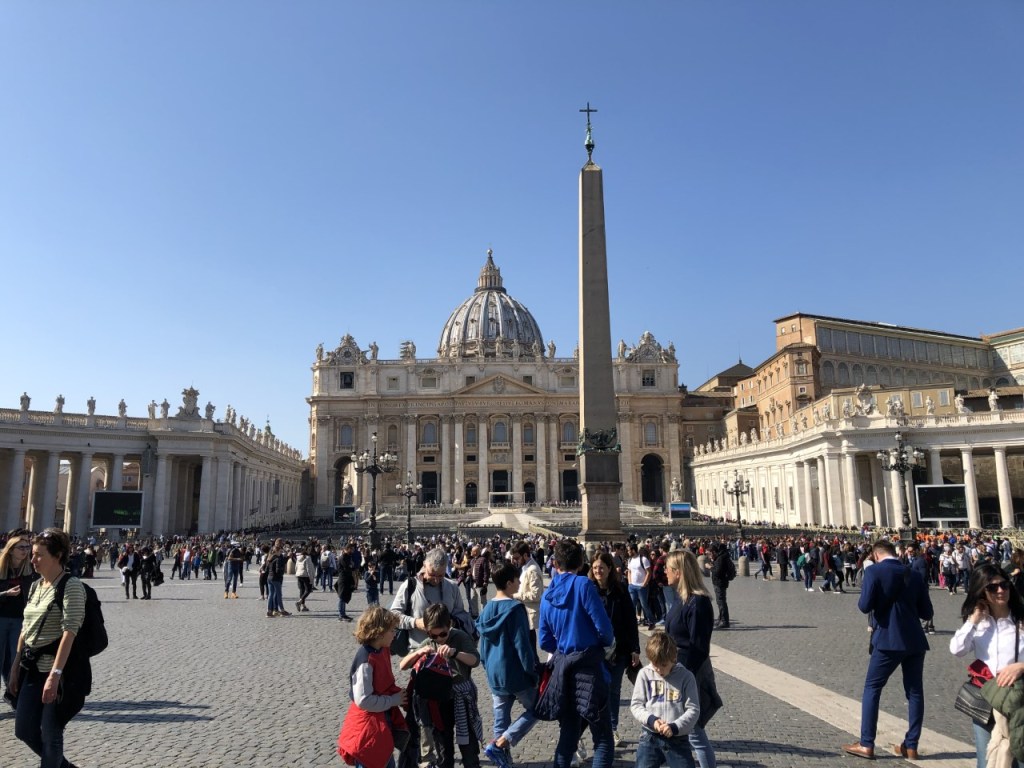
Vatican City is a city-state ruled by the pope who is the head of the Catholic Church. It is the smallest country in the world measuring less than 1/4 square mile and is surrounded by Rome. You can walk around it’s entire 2 mile border in less than an hour. St. Peter’s Basilica and the Sistine Chapel are the two main highlights inside Vatican City for many people, but the Vatican Museums are spectacular as well.
We purchased Faster Than Skip-the-Line tickets through TripAdvisor to see all three. We selected a 10:00am tour in English and were booked with City Wonders tour company. On a previous trip to Rome I decided Vatican City is one of those places it is worth purchasing a tour because you choose a time to enter and have a guide to point out highlights, offer insight, give historical context, and provide fun facts. Also, tours go directly into St. Peter’s Basilica and do not go through a second set of security lines.
A less spendy option is to simply purchase a ticket to the Vatican Museums and Sistine Chapel. This can be done at the door or online. Purchasing tickets at the door usually means a several hour wait and tickets could sell out. If booked online, a booking fee is applied to each ticket, however you get to skip the line and choose the time you enter. Audio guides may also be purchased with the tickets. Tickets may be booked at the Official Vatican Musuem Website.
St. Peter’s Basilica is free to enter but there is a line to get through security which is often an hour or more long.
In Angels & Demons, the main character, Robert Langdon, is rushed to Vatican City to help find a bomb set to destroy the Catholic Church. The Illuminati, a secret society long-thought to be extinct, is thought to be responsible. Langdon races against time to follow clues along the Path of Illumination to save four kidnapped cardinals and find the bomb before it blows up Vatican City.
A couple hours before our Vatican Tour was to begin, Lilly and I checked out of our Airbnb. This gave us time to walk to the Vatican, grab breakfast at one of the many cafes along the way, and store our luggage in a public storage locker, as bags are not allowed in the Vatican. These storage lockers are found throughout Rome and are super handy! We rented a storage locker that fit 2 carry-on suitcases and 2 backpacks for about €10 for four hours.
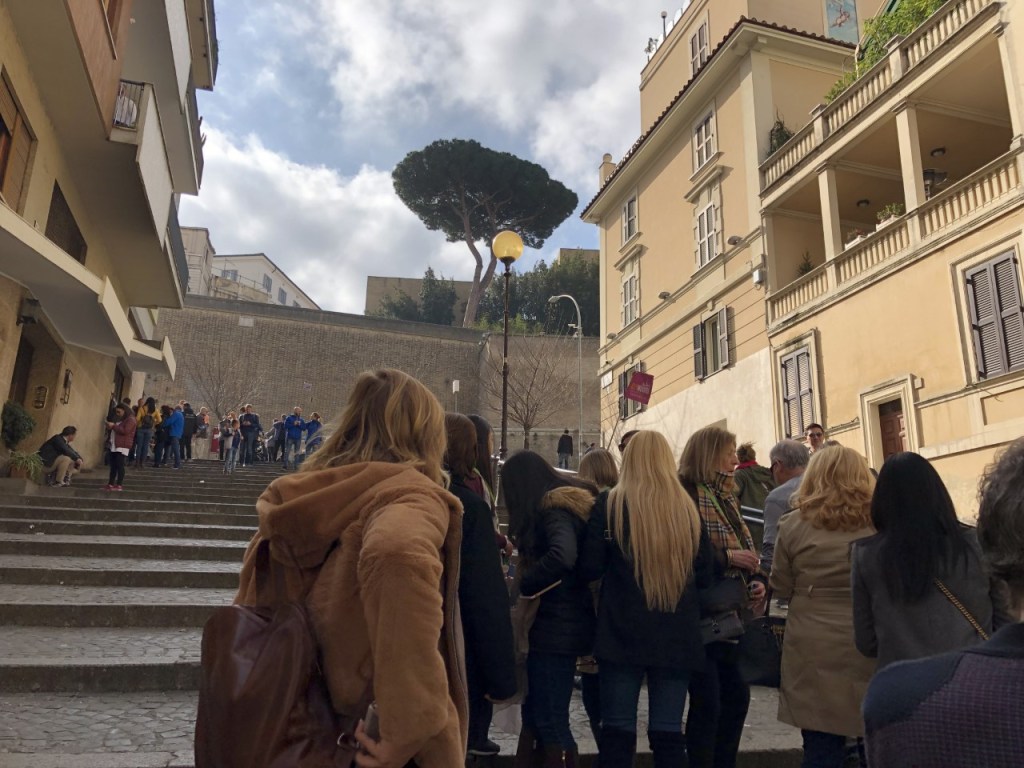
At 9:45am we walked to Via Tunisi 4 to meet our tour group. Several tour groups meet here so we looked for the City Wonders flag and checked in with our guide.
In Angels & Demons, Langdon approaches the Vatican from the air, flying in on a helicopter. He sees the massive Vatican Museum and notes that there would be no time for a museum visit this trip. Lilly and I, on the other hand, approaching on foot through the main entrance, were in for a treat.

On a side note, in the museum lobby, while our guide checked-in, Lilly and I spotted a cappuccino vending machine and decided to try it. We had high hopes that Italian vending machine cappuccinos might be good, and decided to test our theory. Result: Exceptional! Not like any vending machine coffee we’d ever had!
Our tour started in the Pinacoteca Courtyard with our guide explaining some of the history and what we would see. Each person on the tour is loaned a set of headphones tuned to your guide’s channel making it easy to hear everything your guide says.

Inside, we walked through the Gallery of the Candelabra, Gallery of Tapestries, and the Map Gallery. The Gallery of the Candelabra gets its name from the candelabras that, together with marble pillars, separate this hall into six sections. Many classical sculptures, works of art, and relics are displayed throughout the gallery.

The Gallery of Tapestries has two themes displayed. On the right side of the gallery are tapestries commemorating the life of Pope Urban VIII, created in Rome by the Barberini Workshop. On the left are the more spectacular tapestries depicting the life of Christ created by Pieter van Aelst, the best tapestry weaver in Europe during the Renaissance period.

The Map Gallery displays massive fresco maps of the world, created by Ignazio Danti during the sixteenth century. Given the lack of technology at the time they were created, the maps are remarkably accurate. The ceiling in this gallery is a beautiful example of late Renaissance paintings.

As gorgeous as these galleries are, the Raphael Rooms are even more stunning. Raphael Sanzio was an Italian painter and architect of the High Renaissance. In Angels & Demons, he is also a suspected member of the ancient Illuminati who created part of the Path of Illumination which Langdon follows. In reality, back in 1509, Raphael was commissioned by Pope Julius II to redecorate his suite of apartments. The frescos he created are massive and even in a crowded environment you can see them easily given the walls soar approximately 16 feet high with a 25 foot width.


Michelangelo is probably the best known artist from the High Renaissance with the Sistine Chapel ceiling being one of his most famous works. In Angels & Demons he, too, is a suspected member of the ancient Illuminati. It is interesting to note that he appears as one of the philosophers in Raphael’s The School of Athens. His likeness is used for the seated philosopher with his elbow on a stone table at the bottom/middle of the fresco. Raphael and Michelangelo were contemporaries working in the Vatican at the same time.
In Angels & Demons all the cardinals from around the world are locked in the Sistine Chapel holding conclave to elect a new pope. There can be no communication in or out of the chapel until a decision has been reached. This means the whole power structure of the Catholic Church has no idea their lives are in danger should the bomb explode.
The Sistine Chapel, with frescoes by Michelangelo, is simply…beautiful. The most recognizable work is The Creation of Adam, the one where God and Adam touch fingers. It’s in the middle of the ceiling surrounded by other glorious frescoes showing nine scenes from the book of Genesis.
However, it is Michelangelo’s The Last Judgement, a fresco covering the whole alter wall, that captivated me. Soaring 45 feet by 40 feet, it depicts the second coming of Christ and the final judgment. Those who are heaven bound ascend on the left to join the saints, and those who are doomed to hell descend on the right. It created controversy in the early 16th century because of the nude figures. Biagio da Cesena, Papal Master of Ceremonies, commented that it was not fit for a papal chapel but rather for public baths and taverns. In response, Michelangelo painted Cesena’s likeness in with the damned, as Minos, the judge of the underworld, giving him donkey ears, and covering his “objectionable area” with a snake. Legend has it that when Cesena complained to the pope, demanding that his portrait be removed, the pope responded that his jurisdiction did not extend to hell so the painting would have to remain. So…I guess the pope didn’t like Cesena either.
I wish photographs were allowed in the Sistine Chapel but, as they are not, I cannot provide my own images here. However, I’ve included a link to a 3D Virtual Tour of the Sistine Chapel produced by Rome Reports which gives a quick virtual tour.
St. Peter’s Basilica was the final stop on our guided tour. It is named for St. Peter, a disciple of Christ, to whom Jesus said, “You are Peter, and on this rock I will build my church,” (Matthew 16:18). Translations of “peter” mean “rock” (Greek and Aramaic). Tradition says Peter was martyred here by Emperor Nero for spreading Christian beliefs. Three centuries later, Emperor Constantine, the first emperor to convert to Christianity, built a basilica over the Necropolis where tradition says Peter was buried, with the high altar directly over his grave. On this rock (peter) the basilica is built – literally.
In the 16th century Pope Julius II commissioned the basilica that stands today, replacing the old basilica but preserving the original altar, and using the talents of Bramante, Michelangelo, Raphael, and Bernini – masters of the Renaissance.
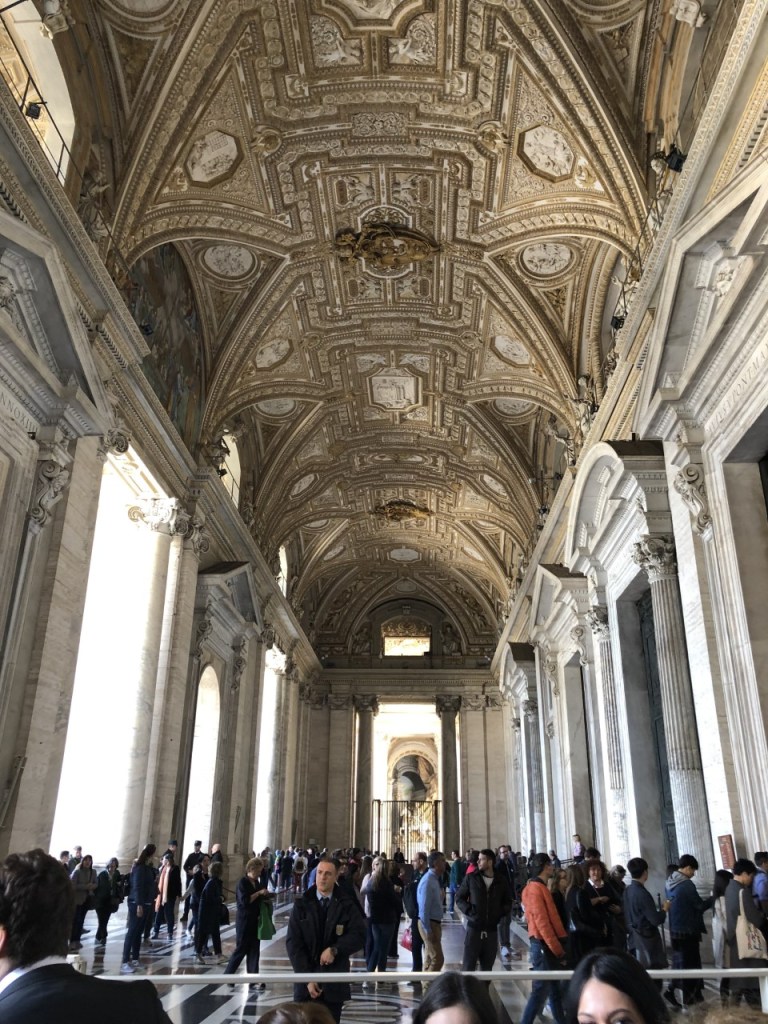
The tour guide takes the group past the line waiting to enter the basilica to some of the major points of interest inside. When the tour ends, after handing back your headphones, you may explore the basilica on your own for as long as you like.
In Angels & Demons there is a scene where the camerlengo, an assistant to the pope, sprints down the main aisle shouting, “Upon this rock I will build my church!” He disappears down the steps of the Confessio, to the Niche of the Palliums, located right in front of the massive Baldachin (or canopy) centered under the dome. He then goes through an entrance to the Necropolis, the graveyard where St. Peter is believed to be buried.

The size of St. Peter’s Basilica is hard to wrap your mind around. The main aisle is about two soccer fields long (720 feet), more than a 200 meter dash. The dome, designed by Michelangelo, soars 394 feet, or about 36 stories.
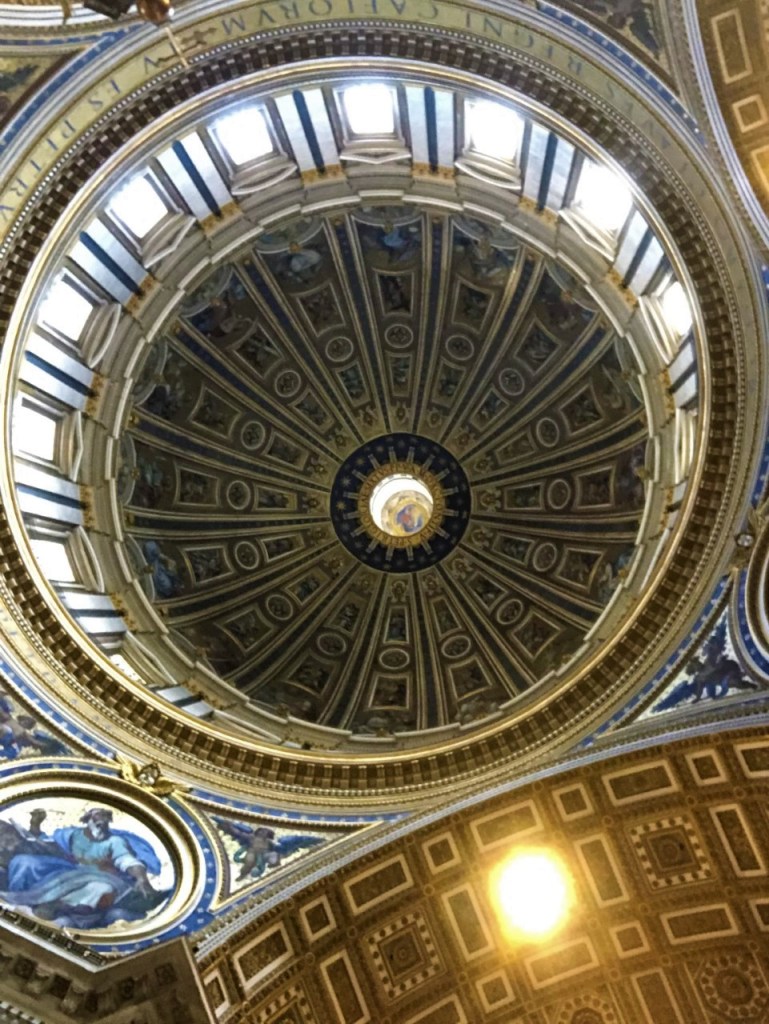
The Baldachin, the massive bronze canopy supported by marble pillars, climbs 94 feet or about 9 stories. Bernini, another artist Angels & Demons links to the Illuminati, was the creator of the Baldachin and the Altar of the Chair of St. Peter.

At the very front of the basilica is the Altar of the Chair of St. Peter. Bernini encased a chair, which tradition held to be St. Peter’s, in bronze and designed an altar around it. The stained glass window above it depicts the Holy Spirit descending as a dove.

The art and architecture displayed throughout the basilica, and the experience of standing in the middle of it, is almost beyond description. Stunning, fascinating, and overwhelming come close, but fall short. From the structure itself, to Bernini’s masterpieces, to Michelangelo’s dome and famous Pieta sculpture, to the embalmed body of Pope John XXIII sealed in a crystal coffin at the Alter of St. Jerome, there are seemingly endless things to see.


After exploring nooks and crannies, our last stop in the basilica was the grottoes. This is the area underneath the basilica holding the tombs of many popes as well as several columns from the original basilica. No photos are allowed. The entrance to the grottoes is under the Statue of St. Andrew.

You can look from the grottoes through glass doors to the Confessio and the Niche of the Palliums. This is the same area accessed from the stairs in front of Bernini’s canopy that, in Angels & Demons, the camerlengo used to enter the Necropolis.
Be sure you are ready to leave the basilica before entering the grottoes because they empty out onto the Patio of St. Gregory the Illuminator, which in turn empties out onto St. Peter’s Square.
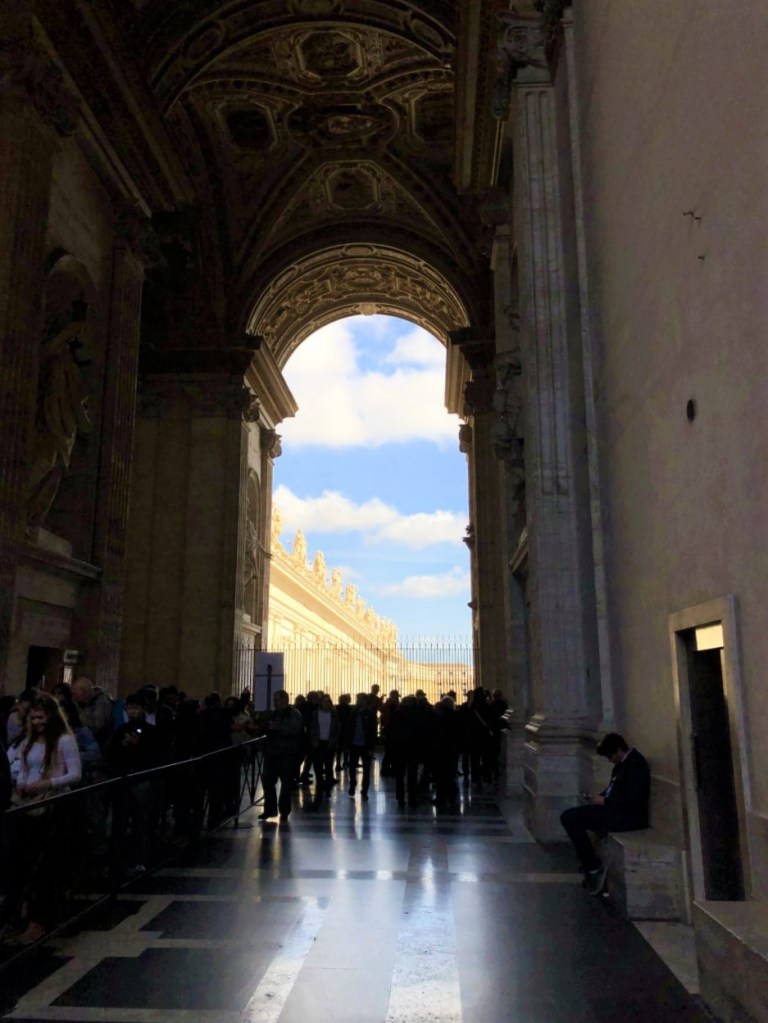


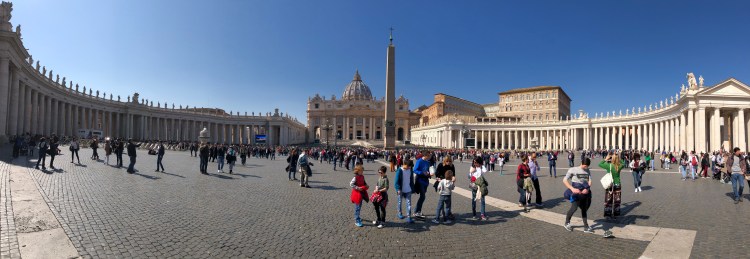
St. Peter’s Square figures into the final scenes of Angels & Demons as Langdon and the camerlengo, in a climactic scene, battle to save the Catholic Church and everyone in the Square. As Lilly and I walked toward the exit, we took one last look at the magnificence of St. Peter’s Square and Basilica.
Leaving the Vatican, it was mid-afternoon and we were hungry for lunch. Fortunately we found a place nearby called Trapizzino that makes pizza pocket sandwiches by the same name. These sandwiches consist of a pizza crust stuffed with meats, vegetables, and sauces.

Lilly had the Pollo alla Cacciatora (Chicken Cacciatore) at the top of the photo, and I had the Polpetta al Sugo (Meatball with Sauce). They were both delicious, but the meatball was my favorite. The recipe I created to replicate the Meatball Sauce is below.
Meatball Sauce Trapizzino
- 1 lb ground beef
- 1 lb ground pork
- 1/2 cup Italian breadcrumbs
- 2 eggs
- 1/2 onion, chopped fine
- 1/4 cup grated Parmesan cheese
- 2 Tablespoons olive oil
- 1 teaspoon minced garlic
- 1 tsp Italian seasoning
- 2 tsp salt
- 1/2 tsp black pepper
- 1 jar marinara sauce
- 1/2 cup water
- Pita or Naan bread
Mix together all ingredients except marinara, water, and bread. Form into balls about 1 inch in diameter and brown in frying pan. When brown on all sides, stir in marinara and water. Bring to a low boil then cover and simmer over low heat for 30 minutes stirring occasionally. Add salt, pepper, and Italian seasoning to taste. Warm pita or naan and serve meatball marinara inside a pita or folded into naan. Serves 4-6.
Mangiamo!
 The Literary Globetrotter